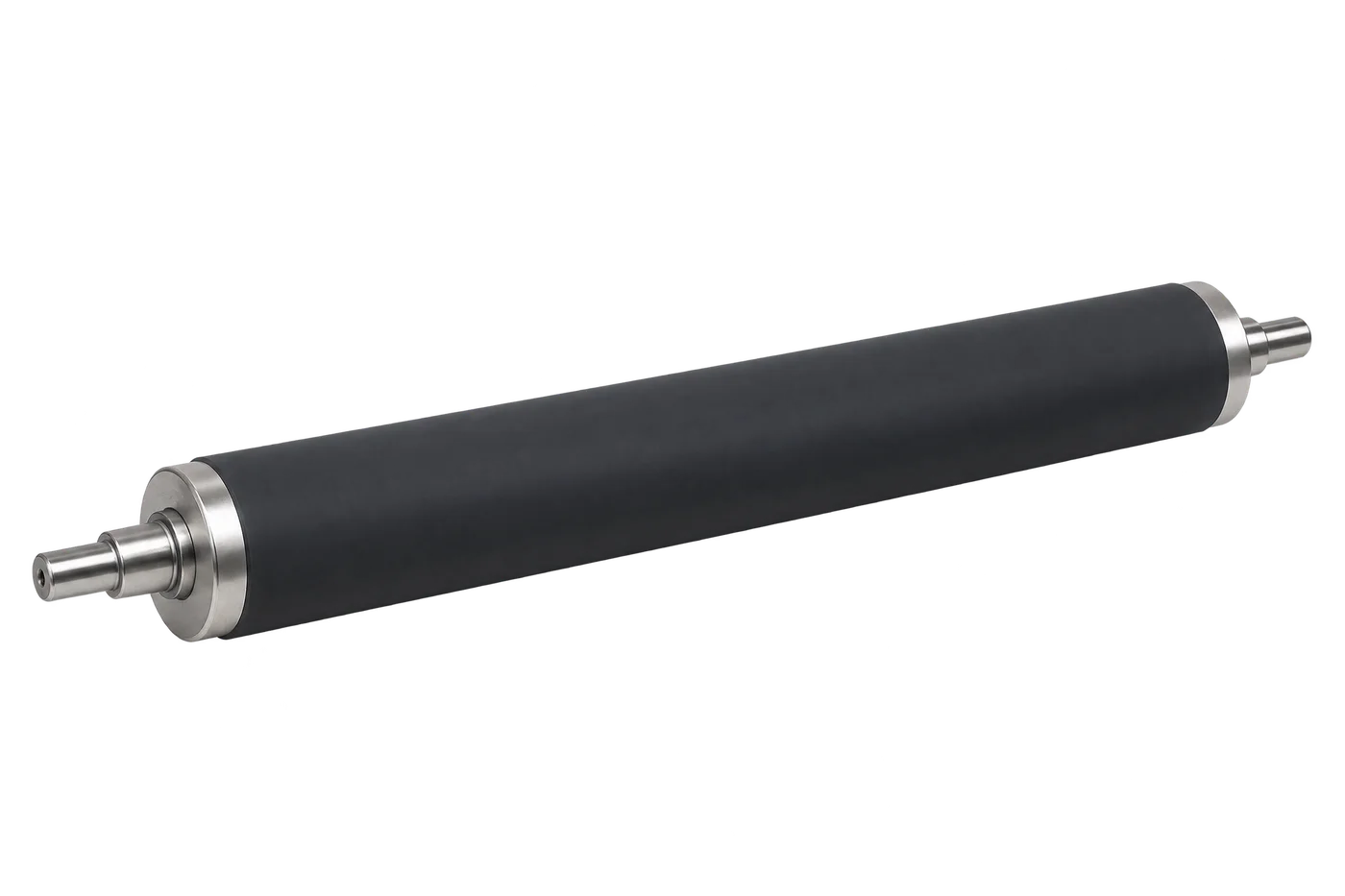
A smooth coating roll and an engraved gravure roll can both transfer liquid to a moving web, but they do not control the liquid in the same way. Start with the coating station and the result required, not just the roll's appearance. The comparison below describes industry methods; it does not imply that Qichao supplies every configuration.
Where the coating amount comes from
In a typical smooth reverse-roll coater, a metering roll and an applicator roll form an adjustable gap. The gap, their relative speeds and the fluid's flow properties influence the film carried to the web. The backup roll and the web's contact conditions also affect transfer. Adjustments can change the delivered coating, but only within a stable operating window for that machine and formulation.
In direct gravure coating, an engraved applicator picks up liquid in its cells or channels. A doctor blade commonly removes excess from the unengraved lands before the remaining liquid transfers to the web. Cell geometry and volume matter, but cell volume is not the final coat weight: only part of the liquid transfers, and fluid properties, contact and operating conditions affect the result. A pattern may remain visible if the liquid does not flow out sufficiently.
“Smooth” describes a surface; “reverse” describes a coating arrangement. Gravure systems can also use reverse or offset arrangements. Do not identify the process from the roller alone: check the machine drawing, roll directions and fluid path. A gravure doctor blade meters excess from the engraved roll; it is not automatically the same component as a comma bar or a blade that meters coating on the web.
How changeovers influence the choice
Consider a line that alternates between two target coat weights. A smooth reverse-roll station may let an operator adjust a metering gap and speed settings within its qualified range. Direct gravure can be a useful candidate for repeatable application at a given condition, but a substantial weight change may require a roll with a different engraving. The actual adjustment range and changeover time depend on the equipment and fluid.
For a thin coating, gravure is worth evaluating, particularly with a low-viscosity fluid. It is not a universal rule: wetting, solids, substrate and coating speed all matter. A higher-viscosity formulation may behave differently in the cells, and pattern flow-out should be checked. Neither method guarantees the lowest waste or the best surface without a trial.
Compare with a controlled trial
Use the same substrate, formulation and target result for both candidates where feasible. Record line speed, relevant gap and speed settings or engraving details, and the sampling method. Compare dry coat weight or thickness using the same measurement basis, then examine coverage, visual uniformity and any pattern. Record cleaning and changeover time as well as material use. Agree acceptable limits before the trial rather than selecting on appearance alone.
Questions to take to the supplier
- What roller position and coating layout does the drawing show? Is the roll an applicator, metering or backup roll?
- What are the substrate, coating chemistry, viscosity, solids content, target coat weight and operating-speed range?
- For smooth-roll coating, what gap and roll-speed adjustments are available? For gravure, what engraving, cell volume and doctoring arrangement are proposed?
- How will the team measure transfer and surface quality, and what would require a different roll or a further trial?
Before cleaning, changing a roller or working near a nip, stop the equipment and follow the site's energy-isolation and lockout procedure: isolate all relevant energy sources, control stored energy and verify isolation. Do not reach into a moving nip. Use only the machine's approved controls for adjustments during a trial.
For a project discussion, share the layout and drawing with Qichao's industrial coating roller team. Design, engraving and manufacturing suitability must be confirmed for the individual enquiry.
Sources
- New Era Converting Machinery: direct gravure coating — engraved-roll transfer and process variables.
- KEYENCE: roll coating methods — examples of gravure, reverse-roll and other coating layouts.